Thursday, October 29, 2015

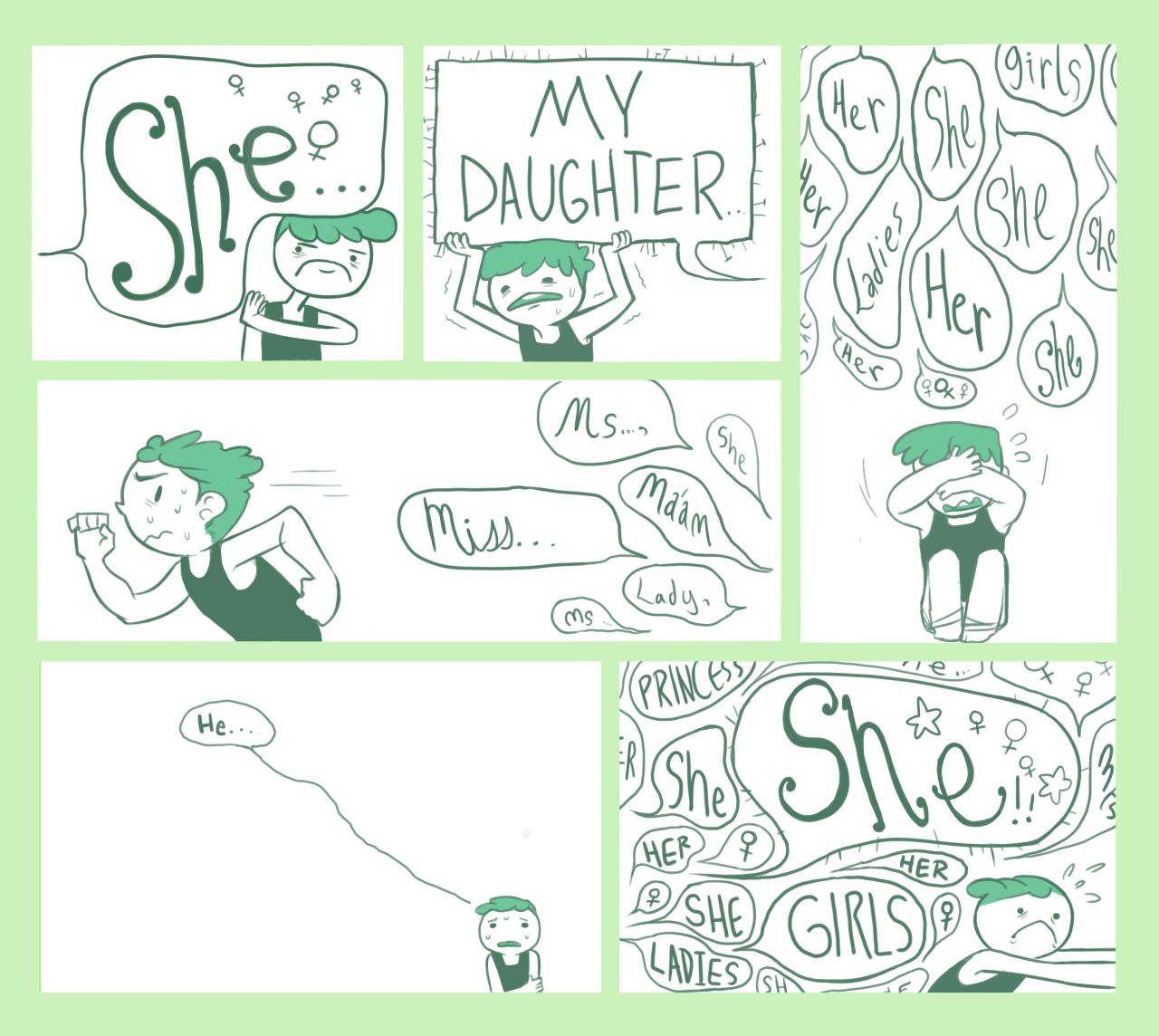
How Can I Avoid Misgendering Someone?

Photo Credit: Robert Gehl

So someone you know came out as transgender, or has asked you to use a different name or pronouns than you were using for them before. Obviously, getting used to referring to someone a different way will not always be an automatic thing. People are creatures of habit by nature. If we're used to doing something one way, we often do it that way without even thinking about it; and while changing that is definitely possible, it takes effort. 

We get it - it's okay! Nobody is perfect and mistakes happen. But obviously, you probably don't want to misgender someone just as badly as they don't want to be misgendered by you. Here are some things I have either tried myself or heard from others that can help you avoid accidentally misgendering someone, or get you used to remembering names and pronouns.

Never Assume

Realize that you CANNOT tell someone's pronouns just by looking at them. 
Gender expression and gender identity are two completely different things.
Recognize that just because someone may look or act in a way that is seen as very masculine, does not mean they identify as a man. 
Recognize that just because someone buys products seen as female-exclusive does not mean they are a woman.
This is the most important thing you can do to avoid misgendering people, even if it's all mental.
If you stop making assumptions in your head, you'll stop making them out loud.

Ask!

If you're unsure of someone's pronouns, just ask! People are a lot less likely to be offended by you asking than they would be if you just assumed and got it wrong. I personally feel very respected when people make the effort to ask instead of just guessing. 

If you're really that uncomfortable just asking someone that right off the bat, get in the habit of introducing yourself with the pronouns you go by.
If you introduce yourself with: "Hi, I'm Tristan and I use xe/xem pronouns"
It's likely you'll get similar info in their introduction back.

Use gender neutral pronouns as often as you can,
 especially in LGBTQIA+ spaces.
I've met women with beards and men with breasts.
I've met nonbinary and agender people that present very feminine or masculine, or are completely androgynous.
So just to clarify again - You CANNOT tell anyone's pronouns just by looking at them.
Which is why using gender neutral pronouns until you are positive of how someone identifies can be a very crucial thing that everyone should really learn to do.
While I think this is important to do no matter where you are, I find it especially important in places where you know there is a large amount of LGBTQIA+ people around.

At my first job I worked in a company that sold feminine clothing,
so we were trained to say "Hello lady/ladies, welcome to *store name*" every time someone came in.
But since clothing is genderless and there was no way to tell if everyone coming in identified as a lady, I got in the habit of saying "Hello everyone" or just simple "Hello, welcome to *store name*,

Some more examples...
Instead of "Mr", "Mrs.", "Miss" say "Mx.", their last name ("Novak" instead of "Mr. Novak"), or avoid the title ("Maya Matlin" instead of "Miss Matlin").
Instead of "He", "She", "Him", "Her", "His", "Hers" etcsay... "They", "Them", "Theirs" etc.
Instead of "You guys" say "You all; Everyone; All of you"
Instead of "That  is for that man/woman over there" say "That is for that person over there". or a descriptor like "That is for the person in the pink shirt".
Instead of "Ladies and Gentlemen" or "Boys and Girls" say "People, Folks, Children", etc.
Instead of "police man", "fireman", "stewardess" etc. say "police officer", "fire fighter", "flight attendant", etc.

Names can also be used in place of any pronouns, like saying:
"That belongs to Clare", "Jonah is not a senior" or "Where did Eli go?"
in place of   "That belongs to her", "They are not a senior", or "Where did he go?"

Look!
Now, before you say that this contradicts what I said about not being able to tell someone's gender identity by looking at them - I don't mean look at the person.

Many people include their pronouns somewhere on social media, like listing them in their Twitter or Instagram bios. Facebook even has an option for gender neutral pronouns to be used in place of he/him or she/her.

I wear a necklace with my pronouns on it almost every day. I've seen people do the same, as well as list them on nametags in appropriate circumstances. While this is not too common, I always check for something like this just to be safe.


Intigrate new information into the old
If you're dealing with someone who has just come out, mix their new info in with the old until you've got it down.

If your friend Gracie now wants to go by Adam you might get confused if you see that name pop up in your text messages and aren't used to calling that person by that name yet.
Try changing their contact info name to something like:
"Adam (Gracie)"
until you remember who that is and can just list them as Adam without being confused.

You can also add pronouns in there if those change too, like:
"Adam (Gracie - He/Him"
"Drew (They/Them)"
"Bianca (Ze/Zir)"
etc.


Practice
I've sat with my laptop open to someone's Facebook pictures and scrolled through them and said their pronouns over and over until they were drilled in my brain along with their face.
I've practiced sentences over and over in my head with someone's new name.
I've heard of people writing their friends' new names or pronouns over and over together so they associate them with each other.
When I joined a group chat with 30+ people I didn't know, I made a document in my phone with everyone's username, name and pronouns and opened it whenever I was on chat until I knew who everyone was and how they identified/
There is nothing wrong with having to do a certain tactic or two to get yourself out of an old habit and into a new one.

--------------------------------------------------------------------------------------------------------------------------

Transgender: Someone whose gender identity does not align with their sex assigned at birth.

Misgender: To invalidate someone's gender; Usually by referring to them by an incorrect gender, incorrect pronouns, or a birth name".

Gender Expression: The way a person externally presents their or any gender identity, or the concept of masculinity vs. femininity

Non-binary: Any gender identity that is not specifically male or female 

Agender: Someone who does not have a gender identity.

Androgynous: Combination of masculine and feminine characteristics 

Gender Neutral: Applicable to any or all genders

LGBTQIA+: Lesbian, gay, bisexual, transgender, queer, questioning, intersex, asexual, plus

Mx.: A gender neutral title, in place of "Mr.", "Mrs.", or "Miss."

Gender Identity: A person's personal perception of their own gender


Tuesday, October 27, 2015

Misgendering: What it is and Why it Matters.

Content Warning: Misgendering.
If you are bothered by the mention of misgendering, please read with caution.


I have defined misgendering on this blog as:

"To invalidate someone's gender; Usually by referring to them by an incorrect gender, incorrect pronouns, or a birth name."

Photo Credit: Sacha

Misgendering is really a very broad topic because it can be done in so many ways, and is likely to effect everyone differently. What one person is offended by may not offend the next and vice versa.

 Someone may be okay with being misgendered in certain situations,
like if they're not out to everyone and don't wish to be...

...While others aren't okay with it under any circumstances.
(This is pretty typical - but it's always best to ask if you're unsure!)

Misgendering can include:

  •  Not using someone's correct pronouns.
  •  Referring to a person with a gender they do not identify as (such as the sex they were assigned at birth.)
  •  Calling someone by their birth name when they have asked to be called something different
  • Asking someone what their "real name" or "real gender" was upon finding out they are transgender.
  • Telling someone their pronouns or gender identity "do not exist" 

Fun fact, not only transgender people are effected by misgendering either...

That cisgender boy on your softball team that everyone jokingly refers to as a girl because he can't pitch as well as the others?

Yep, he's being misgendered.

That girl with the short hair who wears boy clothes and is constantly referred to in a masculine way even though she identifies as female?

Her too. 

Photo Credit: House of Juan


So now on to the big question:

Why does this matter?

If you have siblings, think of this scenario.
*If not, try thinking of a cousin, a parents' sibling, housemate, etc, in place of a sibling:

Have you ever been called by your siblings' name by accident? Of course you have. Because parents are people and make mistakes like the rest of us. 

So your parent calls you by the wrong name and you probably laugh and remind them what name is yours. They probably laugh with you and might say sorry and call you by the correct name this time.

But then it happens again. No big deal...until it happens a third time, and a fourth, and a fifth...

 Your parent is addressing you but keeps using your siblings name instead. At first it was no big deal, but now it's getting annoying. You correct them again, but this time - nothing. They don't laugh, they don't apologize. They just keep doing it like they can't hear you.

Then it spreads. Now it's not just your parent calling you by your siblings name but your classmates, co-workers, other family members, the teller at the bank. No matter how many people you correct, it makes no difference. Everyone is completely set on referring to you by your siblings name.

Some people just ignore you when you correct them. Some stare you up and down like you're a space alien and say "No, your name is..." and insert your siblings' name where your name should be. They start talking to you about all these things your sibling likes that you couldn't give a crap about. When you try to talk about your interests and what you like, they ignore it. They insist they know who you are and what you like to talk about.

 You can't fight it. The more you do and the more angry you get, the more persistent people are on telling you you're wrong. If you get angry, they get angry back. This doesn't just happen for a day. This happens for days, weeks, months, years...for the rest of your life.

You KNOW what your name is, and you know that is who you are. 
You have your own identity. 
But that identity doesn't matter to anybody but you anymore. 
Everyone you meet tells you they know you better than you do.

Think about how you would feel. 
Unheard? Misunderstood? Invalidated? Frustrated?
 Like your feelings don't matter? Like people don't know who you are anymore? 
Unimportant? Irrelevant? Hopeless? Confused? Hurt?

By now, I hope you see the connection. Nobody knows you better than you do, but when someone is misgendered it's telling them the opposite. It's telling them that their gender identity doesn't matter. It's telling them that they can only be who you want them to be, not who they are. Not only is it rude and disrespectful, it's mentally draining. It hurts. It's creating a world where people are not safe being themselves.

--------------------------------------------------------------------------------------------------------------------------

Out: A term used for someone who has already "come out" about how they identify in the LGBTQIA+ community.

Pronouns: A replacement for nouns and noun phrases (He, they, ze, you, etc)

Birth Name: The name someone is given at birth.

Transgender: Someone whose gender identity does not align with the sex they were assigned at birth.

Gender Identity: A person's personal perception of their own gender

Cisgender: Someone whose gender identity does align with the sex they were assigned at birth.


Sunday, October 25, 2015

Being Misgendered

Content Warning: Misgendering.
If you are bothered by talk of being misgendered, please read with caution.


Photo Credit: Sleepyllama


The other day at work I walked in and was greeted by the few of my co-workers that were hanging around like normal. About five minutes into my shift I got a phone call from one of them who wanted to apologize to me for apparently saying "Hey girl!" when she greeted me. Truthfully, I was so tuned in to what I was doing that oddly enough, I didn't even notice what she said. I just took it as any other greeting, said "Hey!" back, and continued on with what I was doing.

This was a rare occurrence in many ways. For one thing, it's not very often I don't notice being misgendered. Even though it's something that happens to me multiple times on a daily basis, it's still one of the worst things I've ever experienced. For me, the  feeling is somewhere between being punched in the gut really hard and realizing I've shown up to school naked. It hurts, it's embarrassing, and it makes me feel exposed and invalidated. It's something I will never get used to, no matter how many times I've lied and told people that I am used to it.

But the thing that really stuck out to me was how my co-worker reacted to what she did. I've received a lot of different reactions when someone misgenders me. Most people don't even realize what they've done, and upon being corrected give me a look like I've just spoken to them in that Ubbi Dubbi language that PBS made up for Zoom back in the 90's.

 A good majority of those people still continue to do it even after being corrected. Some act like I've just told them I'm secretly an alien life-form sent to Earth to scope out the lifestyle, and continue the conversation wide-eyed with things like "Really?!" or "Prove it!". Others act like they've just triggered a bomb that's going to go off in exactly 30 seconds if they don't do everything in their power to make a big deal over their mistake.

I really appreciated the way my co-worker corrected her mistake. Without making a huge deal of it, she apologized, explained why she was doing so and that she understands she made a mistake, listened to me say thanks, and moved on. It was simple, it was calm, and most importantly it was incredibly nice to hear.
--------------------------------------------------------------------------------------------------------------------------

Misgender: To invalidate someone's gender; Usually by referring to someone by an incorrect gender, incorrect pronouns, or a birth name.


Saturday, October 24, 2015

Nicole Maines: Why You Should Know This Name


Content Warning: Genitals. 
If you are bothered by the mention of genitals, please read with caution.
Photo Credit: PD4Pic


Caitlyn Jenner is practically a household name by now since her big gender related interview with Diane Sawyer 8 months ago. But Miss Jenner is not the only transgender woman taking over the world this year. 18 year old Nicole Maines from Maine is a MtF woman, identical twin, and total bad-ass.


Photo Credit: Melissa Jeltsen

When I read about Miss Maines in a Tumblr yesterday, I couldn't believe this was the first time I had heard of her. Well, scratch that. I had heard of her accomplishments, but never knew what name went with them.

When she was only in fifth grade, she fought against her school in what grew to be a huge transgender rights case when they refused to let her use the women's restroom - and won.

She appeared on an episode of Royal Pains, portraying a transgender woman having difficulty with her HRT.

She was the subject of a national best-selling book by Pulitzer Prize winner Amy Ellis Nutt, titled "Becoming Nicole: The Transformation of an American Family". 

On top of these awesome accomplishments, she has also made great strides in her personal life and transition that makes her an inspiration for transwomen everywhere:

She legally changed her name as a child, and won the fight with her family against the court system to keep her personal information private despite other rules in place.

She began puberty blockers at age 12, and has since started taking hormones and has undergone bottom surgery.

On top of all that, she has lived her entire life with a conservative family and gives us a touching story about acceptance and unconditional love.

You can check out more of her story in this issue of People magazine that was released last month.

Keep on keeping on, Nicole! You are a true inspiration!

--------------------------------------------------------------------------------------------------------------------------

Transgender: Someone whose gender identity does not align with the sex they were assigned at birth.

MtF/Transwomen: (Synonymous terms) Male to Female; A transgender woman

Transition: Typically thought of as the time someone stops identifying with the sex they were assigned at birth and starts identifying with their gender identity; may or may not include hormones, surgeries, etc; Can mean something different to every transgender person

Puberty Blockers: Medication used for pre-pubescent adolescents or those who have just began puberty; Used to inhibit the effects of puberty.

HRT: Hormone Replacement Therapy; Boosting the body's supply of specific hormones (typically estrogen or testosterone) through pills, gel, or shots to amplify the effects of that hormone on the body.

Bottom Surgery: Refers to one or many different surgeries that can be done on a persons genitals to reconstruct them for gender-validating purposes.


Thursday, October 22, 2015

Things They Didn't Put on Your Informed Consent Sheet

* The following is from this Tumblr post by user valhallagoon, directed at FtM's who are or are interested in taking testosterone. Valhallagoon (who has since deactivated, unfortunately) shared some of the things learned within the first year of being on testosterone. I thought the post mentioned some pretty interesting things. Some of these I knew already, some I didn't. 


This post mentions food, genitals, menstruation, medication, drinking, injections, birth control, and guns. If you are bothered by any of these things, please read with caution. 
Photo Credit: Zachary Brennan


  1. You’re going to fucking stink to high heaven. That’s puberty. Get a good deodorant, shave your armpits or become a hermit. Even then, you’ll still probably stink.
  2. Right around 3-6 months on T, you’re going to be in itchy, unbearable agony as your new hair grows in. I scratched so badly that I had welts and blisters that scarred. I’d scratch in my sleep. It never stopped. It was brutal. Hydrocortisone cream and anti-itch powders will help. Avoid having your skin damp for prolonged periods. Avoid excessive heat. Don’t wear spandex. Compression clothing such as tight boxer-briefs or binders will make it worse. Crying like a little baby does not help, but you will doubtlessly try this, no matter how manly you think you are. We are all little babies during this time.
  3. Binding causes scars under your arms and on your shoulders. It also causes acne. Cystic acne.
  4. T promotes muscle growth and fat loss… and hunger. If you make bad food choices, you will gain weight, no matter how much you think T is a magic weight loss potion. It is not a magic weight loss potion. On that note, you will gain weight. Muscle weighs more than fat. I dropped 3 clothing sizes but gained 30 pounds in weight. 
  5. Your genitals will hurt. Your dick is going to rub against your underwear or packer if it’s not properly positioned under your skin. You will master the awkward cowboy walk to the bathroom to fix it in a way that draws the least attention. Crying like a little baby does not help, but you will probably do it anyway.
  6. One day, you’re going to wake up and the first thing out of your mouth will sound so unrecognizable that you think you’ve switched bodies with someone else. It’ll be like going from Avril Lavigne to Morgan Freeman overnight. At least, that’s what it will feel like to you. Crying like a little baby is acceptable when this happens.
  7. Everything causes acne. Even your acne meds. You can’t fix it. All you can do is live with it until your hormones stop going haywire.
  8. Some lucky transmen experience temporary uterine insanity. That is, your uterus goes insane and starts cramping randomly. Some endocrinologists theorize that it’s due to the muscles increasing in size from the testosterone so rapidly that they cut off their own blood supply. The pain level from this ranges from “a bear on PCP ate my toe off” and “I just took a shotgun shell full of lemon and rock salt to my external genitalia.” Crying like a little baby does not fix it, but you will do it. You will probably have random bleeding, painful intercourse and lower body weakness. Go to your doctor. Get pain medication. Try to avoid getting addicted to the pain medication. Don’t send nudes of yourself to Pizza Hut when high on the pain medication (as I have done).
  9. Sometimes your voice will break completely in half and you can sing baritone AND soprano. This is great at parties. It gets even greater when you’re drunk.
  10. Drinking before a blood test will mess up your results and may lead your endocrinologist to change your T dose when it’s not necessary.
  11. 100mg/week is not the gold standard magic-making dose. That’s where most endocrinologists put you until you figure out the best dose for yourself, with blood tests to monitor your levels so you don’t make your heart explode. Sometimes it’s more, sometimes it’s less. It’s trial and error. Don’t inject T into a vein. That’s really stupid. Crying like a baby will not help. You’ll probably hurt yourself and look like a giant idiot in the ER.
  12. You will mess up your injections frequently. Golf-ball sized swellings, redness and heat can be common even without infections. Sometimes it will hurt so much that you can’t even walk, sit down, masturbate or shit without being in horrible agony. Cry and move on. Biofreeze will be your best friend. Note: wash your hands after applying Biofreeze, especially before you attempt to use the restroom. Ibuprofen helps with the pain better than tylenol and is less likely to make your liver turn black.
  13. People who don’t know you well, such as your favorite barista or your pharmacist, will stop recognizing you at some point. This is normal. Use it advantageously. 
  14. T will change your emotional responses to things. A lot of people think that it makes you angry and this is not always true. You may have stronger emotional reactions to things. You may have less strong reactions to things. You may get sad where you once got angry, and vice-versa. This is normal. Adapt. If someone tells you that you’re being an asshole, listen to them. It’s also appropriate to tell them to go fuck themselves.
  15. Your informed consent sheet will tell you that your genitals will be drier than the Sahara in the summer. This is not always true. In fact, sometimes the opposite can happen and it’ll be quite swampy. Learn to adapt. Or get Summer’s Eve. Sadly, they don’t make it in Axe scents.
  16. If you’re under 21, it’s possible that you might get taller. Remember the growing pains you used to get as a child? Now imagine those but 500% worse. That’s what it will feel like. You will also have to relearn your spatial relationships with the surrounding world. You will be awkward and clumsy. You will knock things over and be in a constant state of bruised.
  17. You will be less iron deficient on T if you stop menstruating. If you have iron-deficiency anemia, it may clear up entirely.
  18. The copper IUD contraceptive Paraguard can cause your periods to come back. Transgender men looking for an IUD are encouraged to choose Mirena, which is infused with progesterone. Progesterone-only hormonal contraceptives such as Depo-Provera, Implanon/Nexapro, the morning after pill and some daily oral contraceptives are less likely to interfere with your HRT but will likely worsen your acne, cause weight gain and affect your moods. If you are under 25, are on T and have Mirena placed, it is likely your body will reject it. This is very painful and it’d probably be less painful if you stuck both of your feet into a bear trap. You will cry like a little baby. You will also throw up and shit yourself.
  19. Do not attempt to STP while intoxicated. If cis guys can’t control their urine streams while intoxicated, you sure as hell can’t.
  20. And just to piss you off: Testosterone therapy is a subjective experience. No matter how much you can prepare yourself for the changes, you’ll be surprised by what’s happening to you. After you start T, it’s likely you’ll feel lost. You spent a lot of time and mental effort getting to this point and now there’s not much to do but wait. At some point, your changes will slow down. Some day, you’re going to wake up with a beard and not remember the time you didn’t have one. And neither will anyone else. So just be and stop worrying.
----------------------------------------------------------------------------------------------------------------------------------
FtM/Transmen (synonymous terms): A transgender individual who was assigned female at birth, but identifies as male.

Testosterone/T: A steroid hormone used to develop a masculine appearance and features

Binder: A compression vest used to give the appearance of a flattened chest, typically used by those who are FtM.

Binding: The act of using a binder or other materials to give the appearance of a flat chest, typically used by those who are FtM

Packer: A device worn by transmen to give the appearance and feel of a penis. 

STP: A Stand to Pee device used by transmen so they can stand to urinate.

Cis: Cisgender; someone whose gender identity aligns with their assigned sex at birth.

Tuesday, October 20, 2015

Nobody's Perfect...

Photo Credit: Allmyroads

I've realized now as I've gone back through some of my old posts that there are a few places where I have messed up or said some things that are not politically correct. Yes, it's true - I don't know everything (regardless of what my mother thinks).

 One of my favorite things about the ever growing knowledge of gender identity and sexuality is that people are always finding better ways to include everyone and better ways to define things. I actually really like finding out new or more appropriate ways to talk about these things. I think that with knowledge comes power, and the better we get at talking about these topics appropriately the better the community gets. So, with that being said - here's some corrections, and some revisions to terms that I will be sticking with from now on:

LGBTQA+ is now being written as LGBTQIA+, with the added I to include intersex. Also, there were a few posts in the beginning where I failed to note that the Q stands for both questioning and queer. I have since corrected it, but I thought I should bring attention to it anyways.

I have always been on the side that the term 'biological sex' is not offensive, but an article I recently found online (which I am now having trouble tracking down, but I will edit/add in here when I find it) proved me otherwise. From now on, I will be using the term 'sex assigned at birth' instead, or AMAB and AFAB.

^ Which also tweaks the definition of transgender that I have been using on here. From now on, I will be defining the word transgender as "someone whose gender identity does not align with the sex they were assigned at birth".

^ This also changes my definition of cisgender to "someone whose gender identity does align with their sex assigned at birth".

The definition I've been using for sexuality is also changing. This article I stumbled across made a very good point about why the term 'sexual preference' is politically incorrect. So, out with that phrase - and now the definition for these words will simply be "A person's sexual orientation or capacity for sexual feelings.

I'm also changing my definition for genderfluid, as I feel like the original one I came up with just didn't seem right. And of course I want to do my own label justice. From now on, my definition for genderfluid will be "someone whose gender identity fluctuates between two or more points on the gender identity spectrum".

Also, this one's not specifically LGBTQAI+ related, but in past posts I have used the term "trigger warning" to express that what I'm posting may be triggering to some people. I have since learned that the term "trigger warning" is no longer deemed appropriate, and that "content warning" is the more appropriate term. So I will be using that term from this point on if I ever need to again, and will be tagging all needed information with 'cw' instead of 'tw'.
--------------------------------------------------------------------------------------------------------------------------
Gender Identity: A person's personal perception of their own gender

LGBTQIA+: Lesbian, gay, bisexual, transgender, queer, questioning, intersex, asexual, plus

Intersex: Someone who is born with sexual anatomy that does not fit within one label of male or female.

Questioning: Someone who is unsure of their sexuality or gender identity

Queer: An in-group term sometimes used to refer to the entire LGBTQIA+ community, or certain people within the community who define themselves that way

AMAB: Assigned Male at Birth; someone who is born with male sexual anatomy and was originally assigned that label at birth

AFAB: Assigned Female at Birth; someone who is born with female sexual anatomy and was originally assigned that label at birth


Sunday, October 18, 2015

An Awesome Find!


So in my free time I've been teaching myself Pidgin Signed English, a form of sign-language that combines ASL (American Sign Language) and regular American English. I learned ASL in elementary school for about 2 or 3 years, and was pretty good at holding basic conversations.

But I forgot most of it over the years besides the alphabet, religious signs, dirty words, and random words like dinosaur and mustache that were just fun to know. I decided recently  that I really wanted to learn again, and I've officially been obsessed with signing the last few weeks.

While searching to see if there was a sign for genderfluid (after finding there was one for transgender), I came across this video of some ASL signs for some common LGBTQA+ identities and terms. Check it out!!


--------------------------------------------------------------------------------------------------------------------------

Genderfluid: Someone whose gender identity fluctuates between two or more points on the gender identity spectrum

Transgender: Someone whose sex assigned at birth does not align with their gender identity

LGBTQA+: Lesbian, gay, bisexual, transgender, questioning, queer, asexual, plus